


More Than a Gym: Canton’s Stearn Center Faces Cuts to a Generations-Long Community Legacy

Reduced public hours put the future of neighborhood access in focus at an institution rooted in the Canton Police Boys Club.
330 Local News | On The Corner | October 29, 2026

CANTON, Ohio — The loss of city funding and a reduction in public hours at the J. Babe Stearn Community Center raise a question that reaches beyond one nonprofit’s finances: how does Canton sustain the neighborhood institutions that have helped generations of young people find recreation, guidance and opportunity?
The center’s roots connect police officers, youth sports and the beginnings of the Bluecoats. Its namesake’s community work also reached into Canton’s efforts to improve racial relations.
That history gives the current service changes a broader significance.
What has changed
The Canton Park Commission decided in May to end its funding contract with the center, according to an October 28 report by Abreanna Blose of The Canton Repository. Approximately $300,000 a year in parks levy revenue represented about 60% of its budget.
The center has since eliminated its 6–8 p.m. public-access period and reduced staff hours. Youth programming continues, and interim director Steve Norch told the newspaper that restoring evening access depends on funding.
Parks Director Doug Foltz described the partnership as “no longer a good fit.” The report said the commission had not decided where the money would go next.
A separate leadership dispute has also become public. The board confirmed that longtime staff member and executive director Tim Haverstock’s employment ended September 28. Haverstock challenged accounts that he retired; the board declined to discuss personnel details. The funding decision preceded his dismissal.
Those are distinct developments. The available reporting does not establish that the personnel dispute caused the loss of city support. [1]
The man behind the name
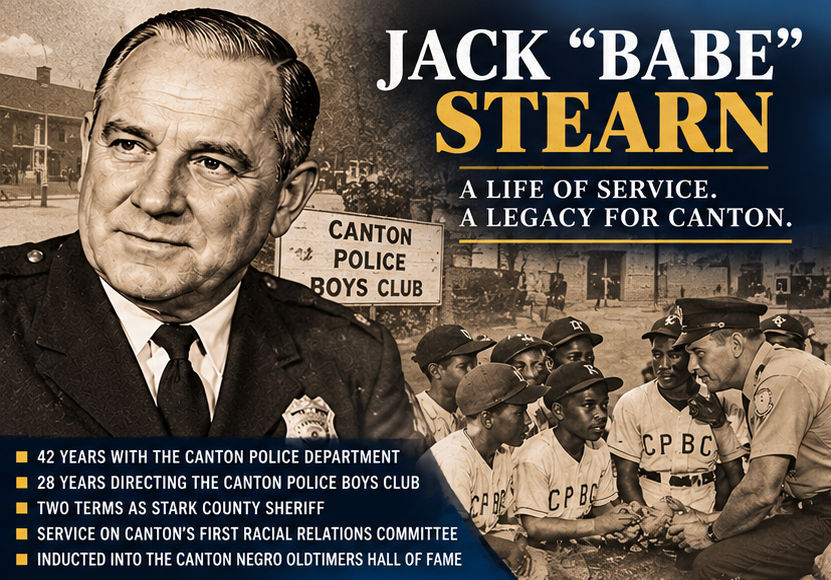
Jack “Babe” Stearn arrived in Canton as a young immigrant from Russia and built a life in public service. His 2007 obituary, published by The Repository, records 42 years with the Canton Police Department, 28 years directing the Canton Police Boys Club, and two terms as Stark County sheriff after his election in 1984.
His work with young people included Mighty Mite baseball, a summer camp in Sandyville and the development of the Bluecoats. The obituary dates the dedication of the community center bearing his name to 1991.
It also records his service on Canton’s first Racial Relations Committee and his induction into the Canton Negro Oldtimers Hall of Fame. Those details place his legacy within a wider civic history, extending beyond law enforcement and athletics. [2]
They do not, by themselves, establish that every family experienced the club in the same way. They do document relationships across several parts of Canton’s community life.
A place where music took root

The Bluecoats’ own history traces the corps to a musical program at the Canton Police Boys Club.
In the late 1960s, officer Ralph McCaulley gained Stearn’s approval to develop the ensemble. Local tailor and drum-corps veteran Art Drukenbrod joined the effort after seeing the group in the Hall of Fame parade.
The organization identifies December 3, 1972, as its official founding date. Its name honored retired police officers and its connection to the Boys Club.
That connection illustrates how a neighborhood youth institution can create opportunities whose reach extends far beyond its original rooms and playing fields. [3]
A recurring question about public support
Canton’s official council record shows that concern over the center’s funding is not new.
At the April 16, 2012, council meeting, a member recalled attending as a child and praised David Miday and Tim Haverstock’s continuing work. The discussion contrasted an earlier annual city contribution of $150,000 with a then-current $15,000 appropriation.
Those figures describe an earlier period and funding arrangement. They are not directly comparable to the recently terminated parks contract. But the record shows that the question of sustaining the center has surfaced across different city administrations and budgets. [4]
A Foundation for Community Betterment account of its 2010 support likewise describes the center’s combination of sports and mentoring. Its donation helped a young person participate through an athletic scholarship. That is a historical example, not a current enrollment count. [5]
What the history asks of Canton now

The Stearn Center’s history cannot answer every question about its present finances or management. It does help explain why reduced access deserves public attention.
The next questions are practical: What funding can support evening access? Where will the former city allocation be spent? And how will residents learn which services remain available?
Preserving a community legacy requires more than remembering a name on a building. It requires a clear account of the opportunities available inside it—and a sustainable plan for keeping those opportunities within reach.
Sources
Abreanna Blose, The Canton Repository, October 28, 2026 — syndicated by AOL. Current funding, service and leadership reporting.
Jack “Babe” Stearn obituary, The Repository, January 12, 2007. Biographical and civic-history details.
Bluecoats — Official history. Primary organizational account of the Boys Club connection and founding.
Canton City Council proceedings, April 16, 2012. Historical funding discussion on journal page 300; retrieved through indexed official text.
Foundation for Community Betterment — Stearn Center, 2010 recipient. Historical program and scholarship support.


Comments