


Remembering Sonny Rollins

A reflection on the tenor giant’s restless brilliance, lasting warmth, and singular sound
DJTen | RadioActive1 WBOB | June 8, 2026
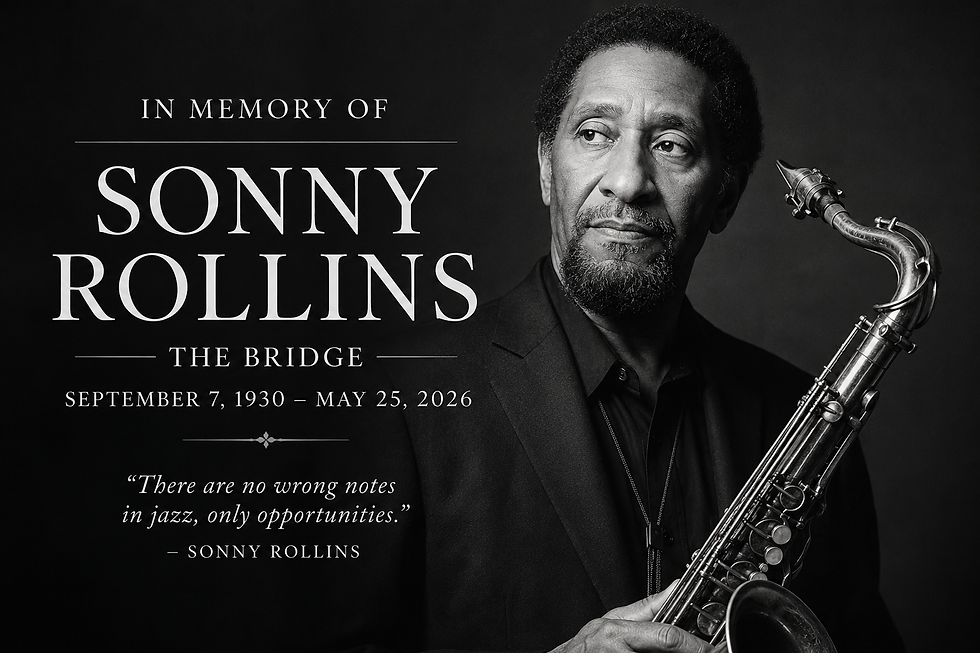
When Sonny Rollins died at 95, jazz lost more than a master improviser; it lost one of its clearest examples of artistic courage. Few musicians sounded so unmistakably like themselves. His tenor tone could be huge and playful one moment, searching and severe the next, and through it all came the sense of a mind testing every idea in real time. Rollins did not simply extend the language of modern jazz. He made improvisation feel newly alive—open, risky, and full of wit.
Saxophone Colossus, released in 1956, remains the most famous entry point into his work, but its stature is deserved. The album captures Rollins at full power: intellectually agile, rhythmically inventive, and wholly unafraid of surprise. Compositions such as “St. Thomas,” “Oleo,” “Doxy,” and “Airegin” have endured because they do more than showcase craft; they invite reinterpretation. Rollins could worry a melody, reshape it, tease it apart, and then return it to the listener with even greater force. What made that brilliance last was the human quality inside it—the humor, the warmth, and the unmistakable pleasure of invention.
Part of Rollins’s stature came from the rigor he brought to his own development. At the height of his acclaim, he stepped away from public performance to practice, reflect, and reimagine what he wanted from the music. The image of him on the Williamsburg Bridge has become central to his legend because it expresses something essential about his character: he refused to rely on reputation. Even after playing alongside figures such as Charlie Parker, Miles Davis, Thelonious Monk, and Max Roach, Rollins remained committed to becoming something larger than the sum of his associations. He was always listening for the next possibility.
By the time major honors arrived, including the Grammy Lifetime Achievement Award and the Kennedy Center Honors, they felt less like discoveries than acknowledgments of what had long been true. Rollins belonged among the indispensable voices of American music. Yet his greatness was never merely institutional or historical. It lived in the architecture of a solo, in the slyness of a rhythmic turn, and in the way a phrase could suggest comedy, argument, or lyric grace within a matter of bars. That is why his recordings continue to feel present rather than preserved. They do not ask to be admired from a distance; they still compel engagement.
“He made improvisation feel less like display than discovery.”
To remember Sonny Rollins is to remember an artist who treated mastery not as a destination but as a discipline of continual searching. He leaves behind a body of work that helped define modern jazz, but also a rarer inheritance: the example of a musician who never stopped demanding more from himself or from the form he loved. Long after the last chorus fades, that example remains—like a tone still hanging in the air, warm and unhurried, refusing to disappear. So does the sound.
Rest in Music, Sonny... Rest in Music


Comments