


America at 250: The Promise Series - September 4: Two Generations, the Same Promise

History has a way of placing events beside one another that, at first glance, seem unrelated. September 4 is one of those dates.
By Walter Sundiata | RadioActive1 Back On The Block | September 4, 2026

History has a way of placing events beside one another that, at first glance, seem unrelated.
September 4 is one of those dates.
On September 4, 1875, racial and political tensions in Clinton, Mississippi erupted into violence during a Republican political gathering attended by Black citizens and white Republicans. The immediate death toll included five African American and three white men. Over the next several days, an estimated fifty African Americans were killed. What became known as the Clinton Massacre was part of a much larger campaign of intimidation and violence aimed at undermining Black political participation during Reconstruction.
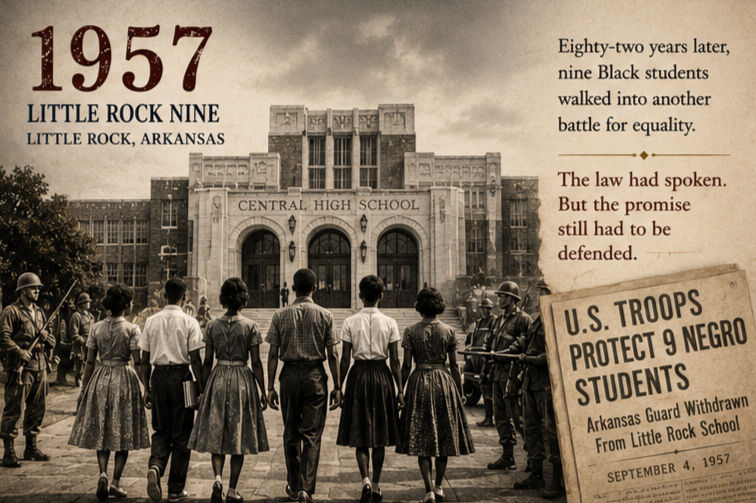
Eighty-two years later, on September 4, 1957, nine Black students attempted to enter Central High School in Little Rock, Arkansas.
They, too, encountered resistance.
Different century.
Different circumstances.
Different battlefield.
But beneath both events was essentially the same question:
Would America honor the promise of citizenship and equality it had made to its Black citizens?
The Promise After Emancipation

The Civil War had ended only a decade before the violence in Clinton.
Slavery had been abolished. Black men had gained citizenship and voting rights through the Reconstruction Amendments. Across the South, former slaves were voting, holding political office, building schools, establishing businesses, and participating in government.
On paper, America had made an extraordinary promise.
In practice, that promise was under attack.
White supremacist organizations and armed political groups used intimidation and violence throughout the Reconstruction South to suppress Black voting and destroy the interracial political coalitions that had emerged after the war.
Clinton, Mississippi, became one of the places where that struggle turned deadly.
The details matter.
But so does the larger lesson.
A constitutional right means little if people can be terrorized for attempting to exercise it.
Eighty-Two Years Later
By 1957, America had changed dramatically.
Reconstruction was history.
The country had fought two world wars.
Black Americans had served their country overseas, contributed to its economy, built communities, and continued demanding the rights supposedly guaranteed to them generations earlier.
And yet, on September 4, nine Black teenagers arrived at Central High School in Little Rock and discovered that another American promise still required defending.
Three years earlier, the Supreme Court’s decision in Brown v. Board of Education had declared state-sponsored segregation in public schools unconstitutional.
The law had spoken.
But once again, there was a distance between the promise on paper and the reality on the ground.
Arkansas Governor Orval Faubus deployed the Arkansas National Guard around Central High School, preventing the students from entering.
Among them was 15-year-old Elizabeth Eckford, whose image walking alone through an angry white crowd became one of the defining photographs of the Civil Rights Movement.
Eventually, President Dwight D. Eisenhower federalized the Arkansas National Guard and sent members of the 101st Airborne Division to enforce the students’ entry into Central High.
Once again, the promise had to be defended.
History Is Not Always Comfortable
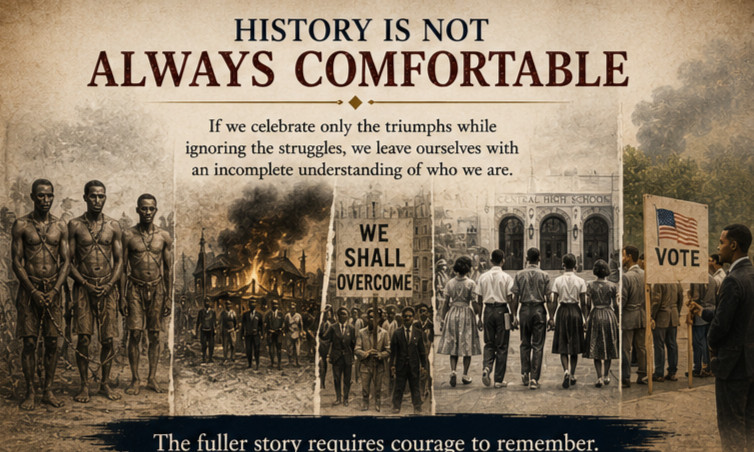
These aren’t comfortable stories.
They aren’t supposed to be.
History tells us about extraordinary achievement and remarkable courage. But it also forces us to confront injustice, intolerance, violence, and promises broken.
If we celebrate only the triumphs while ignoring the struggles, we leave ourselves with an incomplete understanding of who we are.
The story of America has never been one of perfection.
It has been the story of a nation repeatedly challenged to become more faithful to the ideals it proclaimed at its founding.
And perhaps that is what makes September 4 so revealing.
In 1875, Black Americans were attempting to exercise newly won political rights.
In 1957, Black children were attempting to exercise a constitutional right to equal education.
Eighty-two years separated them.
But in both cases, ordinary Americans found themselves asking their country to honor promises it had already made.
A Promise Still Believed In

That’s the thread running throughout our America at 250: The Promise Series.
Promises Made.
Promises Spoken.
Promises Kept.
Promises Broken.
A Promise Still Believed In.
The people gathered in Clinton could have surrendered their political aspirations.
The Little Rock Nine could have decided that walking through those doors wasn’t worth the hatred waiting on the other side.
Generation after generation could have concluded that America’s promises were simply words on old pieces of paper.
But they didn’t.
They kept registering.
They kept voting.
They kept marching.
They kept going to school.
They kept organizing.
They kept challenging the courts.
They kept demanding that America become what America said it was.
Some paid with their livelihoods.
Some paid with their freedom.
Some paid with their lives.
Yet the promise survived because people refused to surrender it.
That is why remembering the uncomfortable parts of our history matters.
Not because America’s failures are the whole American story.
But because neither are its triumphs.
The fuller story is found somewhere between the two—in the generations of Americans who confronted the contradiction and kept pushing the country forward.
In spite of it all, we never stopped believing.
And 82 years apart, on the very same date, Clinton, Mississippi, and Little Rock, Arkansas, remind us just how much that belief has sometimes cost.
America at 250: The Promise Series continues…
Because history isn’t just about remembering where we’ve been. It’s about deciding where we’re going next.


Comments