


America at 250: The Promise Series - The Promise Demanded

The March on Washington Was More Than a Dream
By Walter Sundiata | RadioActive1 WBOB | August 24, 2028

On August 28, 1963, a quarter of a million people gathered at the Lincoln Memorial to insist that America honor promises it had written into its founding documents but repeatedly denied to Black citizens. Dr. Martin Luther King Jr. gave that demand its most enduring language. But the day was never only about a dream.
It was the March on Washington for Jobs and Freedom. Its name was a declaration of purpose, joining the struggle against segregation and voter suppression to the struggle for employment, housing, education and economic security. The dream was unforgettable. The demands were specific. And sixty-three years later, the difference between remembering one and confronting the other still matters.
A Promise Written - and Unpaid
King began by looking backward. One hundred years after the Emancipation Proclamation, he told the nation, Black Americans remained confined by segregation and discrimination. Then he reached further back, to the Declaration of Independence and the Constitution. Those documents, he argued, carried a promise that the rights of life, liberty and the pursuit of happiness belonged to every American.
His central metaphor was financial. America had issued a promissory note and then defaulted when Black citizens attempted to collect. The March came to Washington to present that unpaid obligation. King did not ask the country to invent an entirely new creed. He demanded that it honor the one it already claimed as its own.[1]
The March came to collect on America's unpaid promise.
That argument makes the March a natural part of America at 250: The Promise Series. The nation's history is not simply a record of ideals announced. It is also the record of people who forced those ideals to confront reality. On August 28, 1963, Americans who had been excluded from the full benefits of citizenship placed the contradiction before the government, the television cameras and the world.
The March Before the March
The story did not begin with King at the Lincoln Memorial. Its roots reached back more than two decades to Black labor leader A. Philip Randolph, president of the Brotherhood of Sleeping Car Porters. In 1941, as defense industries expanded for World War II while excluding many Black workers, Randolph threatened to bring thousands of demonstrators to Washington.
President Franklin D. Roosevelt responded by issuing Executive Order 8802, barring discrimination in defense employment and creating a federal fair-employment committee. Randolph called off the demonstration, but the lesson endured: disciplined mass action could compel the federal government to move.[2]
By 1963, a wave of sit-ins, Freedom Rides, demonstrations and local campaigns had exposed the brutality required to maintain segregation. Birmingham had filled television screens with images of police dogs and fire hoses turned on protesters. Medgar Evers had been murdered outside his Mississippi home. President John F. Kennedy had proposed civil-rights legislation, but movement leaders understood that proposals could be weakened, delayed or buried. Randolph revived the march as a way to join the power of the civil-rights movement with the economic demands of organized labor.
The Architect Behind the Day

Randolph supplied the authority and vision. Bayard Rustin supplied the plan.
Rustin had spent decades organizing for racial equality, labor rights, peace and nonviolent direct action. He was also a gay Black man at a time when his sexual orientation was routinely used to discredit him. Opponents threatened to make him the story. Some allies preferred that he remain outside the spotlight. Yet the success of the March depended heavily on his experience and precision.[3]
Working from a crowded Harlem headquarters, Rustin and a small staff coordinated trains and buses, recruited volunteers, arranged sound and sanitation, trained marshals, negotiated with public officials and built a coalition of civil-rights, labor and religious organizations. What appeared on television as a peaceful and almost effortless gathering was the result of intense preparation.
Rustin's story complicates the comforting myth that history turns on a single speech or charismatic leader. Movements require vision, but they also require schedules, telephones, transportation, budgets, compromise and people capable of converting moral urgency into collective action.
Wasn't Just a Dream - It Was a List of Demands

Public memory has shortened the event's name and, in doing so, narrowed its meaning. The marchers did not travel to Washington only to seek relief from segregation. They demanded a comprehensive civil-rights law; protection of voting rights; integrated education and public accommodations; decent housing; fair-employment practices; job creation; training; and stronger federal enforcement.[4]
The word Jobs came first for a reason. Randolph and Rustin understood that legal equality without economic power could leave freedom incomplete. A person might gain the right to enter a restaurant while still lacking a job that paid enough to eat there. A family might be legally entitled to housing while discrimination and poverty kept entire neighborhoods beyond reach. A ballot could open the door to political power, but only if citizens were protected when they tried to use it.
This broader agenda prevents the March from being reduced to a ceremony of racial goodwill. It was a protest against public segregation and private discrimination, against voter exclusion and economic deprivation. It insisted that civil rights and economic justice were not separate promises.
A Coalition with Tensions
The March represented an extraordinary coalition, but unity did not erase disagreement. The clearest example came from John Lewis, the twenty-three-year-old chairman of the Student Nonviolent Coordinating Committee and the youngest speaker on the program.
Lewis's original text condemned the Kennedy administration's civil-rights proposal as “too little and too late.” Other march leaders, labor representatives and Catholic officials objected to portions they considered too militant. Lewis agreed to revisions shortly before taking the podium, though his final speech still warned that Black citizens could not be patient while violence and injustice continued.[5]
The episode revealed a recurring movement tension: how far should organizers compromise to preserve a coalition, and when does unity become an excuse for muting the people closest to the struggle? The March was powerful because diverse organizations stood together. It was also shaped by negotiations over which voices the nation was prepared to hear.
The Women the Program Nearly Silenced

That problem was even clearer in the treatment of women. Black women had organized boycotts, raised money, registered voters, led local campaigns, endured violence and sustained the institutions that made the movement possible. Yet the original March program included no woman as a principal speaker.
Dorothy Height was the only woman among the senior organizing leadership commonly associated with the “Big Six,” and Anna Arnold Hedgeman was the only woman on the administrative committee. Hedgeman protested the absence of women's voices, leading to a hastily arranged tribute. Daisy Bates delivered brief remarks, while women such as Rosa Parks, Gloria Richardson, Diane Nash, Myrlie Evers and Elvira Turner - the widow of murdered voting-rights activist Herbert Lee - were recognized rather than given the same speaking authority afforded male leaders.[6]
The contradiction should not be hidden to protect the March's legacy. It should be studied as part of that legacy. A movement can challenge one form of exclusion while reproducing another. Remembering the women who carried the movement forward does more than correct the record; it sharpens our understanding of what equality demands from institutions and movements alike.
The Speech the Nation Remembers
King was the final speaker. He began with a prepared address anchored in the nation's unfulfilled promises. Near the end, he moved into language he had developed in earlier sermons and speeches, including a June 1963 address in Detroit. Gospel singer Mahalia Jackson, positioned nearby, urged him toward the dream. King set aside his manuscript and began the passage that would enter history.[1]
The power of “I Have a Dream” came partly from its ability to hold indictment and hope together. King described an America disfigured by racism while refusing to surrender the possibility that it could change. His dream was not passive optimism. It rested on organized struggle, sacrifice, legislation and the willingness to return home and continue working after the crowd dispersed.
That context matters because the speech has often been transformed into a general appeal for kindness or colorblindness. King was not asking Americans to stop noticing race. He was demanding that they confront the systems that made race a barrier to citizenship, safety and opportunity.
What the March Helped Move
The March did not create the Civil Rights Act of 1964 or the Voting Rights Act of 1965 by itself. Those victories grew from decades of litigation, local organizing, boycotts, direct action, political pressure and sacrifice. But the March demonstrated the movement's national reach and strengthened the demand for federal action. Its leaders met with President Kennedy and Vice President Lyndon B. Johnson that afternoon to press for stronger civil-rights legislation.[4]
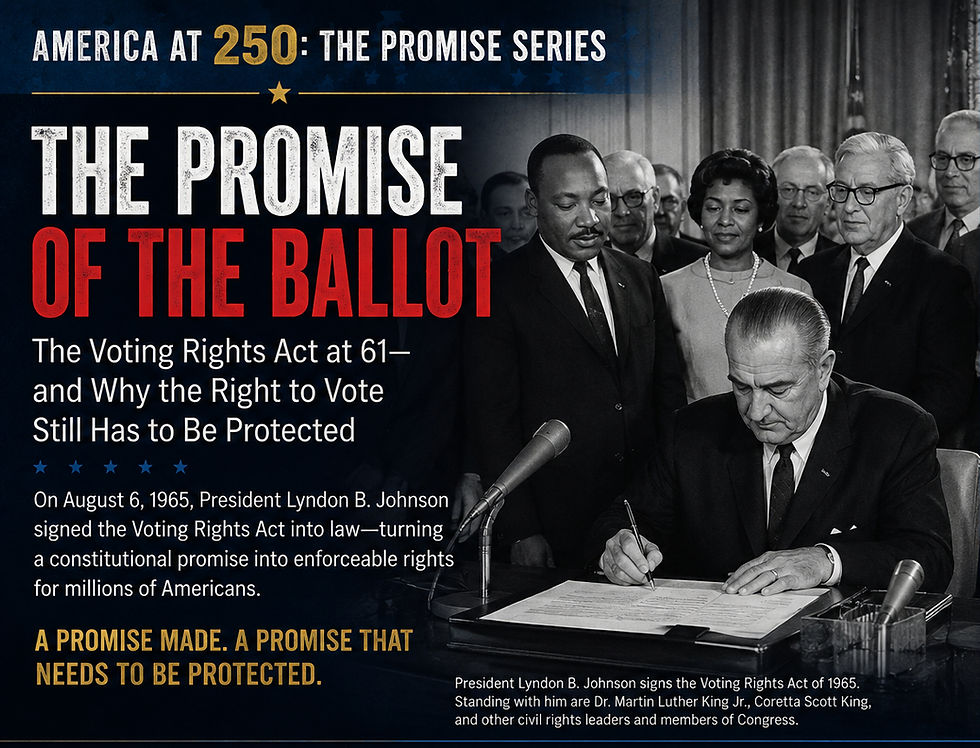
The Civil Rights Act attacked segregation in public accommodations and employment discrimination. The Voting Rights Act gave the federal government powerful tools to confront discriminatory practices that had kept generations of Black citizens from the polls. Together they changed the legal structure of American life.[7]
The victories were real. So were their limits. Laws require enforcement. Rights can be narrowed by courts, weakened by officials, obstructed by states or made difficult to exercise in practice. The years after 1965 would show that legal equality, political power and economic justice move on different timelines - and that progress does not protect itself.
The Promise Still Unfinished
The unfinished portion of the March's agenda is visible whenever voting access becomes harder, housing opportunity remains divided or economic security follows racial lines. The Federal Reserve reported that the median wealth gap between White and Black families exceeded $220,000 in 2022, even though the typical Black family experienced significant wealth growth during the preceding three years.[8] In July 2026, the Black unemployment rate was 6.3 percent, compared with 3.6 percent for White workers.[9]
Those figures do not mean the country is unchanged since 1963. They demonstrate why the March's dual demand remains so important. Freedom cannot be measured only by the removal of a “Whites Only” sign. It must also be measured by whether people can vote without obstruction, find decent work, earn fair wages, secure housing, educate their children and participate fully in the institutions governing their lives.
The March also offers a warning for the present. When its history is compressed into a few inspirational lines, the nation can praise the dream while avoiding the demands. It can celebrate King as a symbol while ignoring the organizing methods, policy goals and economic critique that gave his words their force.
From Dream to Responsibility
Sixty-three years after the March on Washington, the task is not to decide whether the dream was beautiful. It was. The task is to remember what the dream required.
It required A. Philip Randolph to spend decades connecting labor rights and civil rights. It required Bayard Rustin to build an event whose success could not be left to chance. It required young organizers such as John Lewis to push national leaders beyond what they considered politically comfortable. It required Black women to continue leading even when the movement failed to give them an equal place at the microphone. And it required hundreds of thousands of ordinary people to travel to Washington and make the nation look at itself.
The March gave America a dream to remember. It also presented a list of obligations the country remains responsible for meeting. Honoring August 28, 1963, requires more than repeating its most familiar words. It requires continuing the work those words were meant to inspire.
A dream remembered is history. A demand answered is progress.
Research Sources
[1] Martin Luther King, Jr. Research and Education Institute, “I Have a Dream,” August 28, 1963. Read source
[2] Martin Luther King, Jr. Research and Education Institute, “March on Washington for Jobs and Freedom.” Read source
[3] National Park Service, “The Places of Bayard Rustin.” Read source
[4] Library of Congress, “The Day of the March.” Read source
[5] Library of Congress, “A Long Struggle for Freedom: The Civil Rights Era,” including the original and revised John Lewis speech. Read source
[6] Martin Luther King, Jr. Research and Education Institute, “Freedom! Black Women Speak at the March on Washington for Jobs and Freedom.” Read source
[7] National Park Service, “National Headquarters, March on Washington for Jobs and Freedom.” Read source
[8] Board of Governors of the Federal Reserve System, “Greater Wealth, Greater Uncertainty: Changes in Racial Inequality in the Survey of Consumer Finances,” October 18, 2023. Read source
[9] U.S. Bureau of Labor Statistics, “Employment Status of the Civilian Population by Race, Sex, and Age,” July 2026. Read source
[10] National Park Service, “March on Washington for Jobs and Freedom.” Read source
[11] Smithsonian American Women’s History Museum, “1963 March on Washington.” Read source


Comments