


America at 250: The Promise Series: The 19th Amendment: A Promise Expanded, a Right Still Contested

On August 18, 1920, Tennessee became the 36th state to ratify the 19th Amendment, providing the final approval needed to add it to the United States Constitution.
By Walter Sundiata | RadioActive1 WBOB | August 17, 2026

On August 18, 1920, Tennessee became the 36th state to ratify the 19th Amendment, providing the final approval needed to add it to the United States Constitution.
Its words were brief but revolutionary:
“The right of citizens of the United States to vote shall not be denied or abridged by the United States or by any State on account of sex.”
Eight days later, on August 26, the amendment was officially certified.
After generations of organizing, petitioning, marching, speaking, writing, lobbying—and sometimes risking arrest—women had forced the nation to recognize that democracy could no longer be defined as government by men alone.
It was a historic victory.
But like so many promises in American history, the promise of the 19th Amendment was more complicated than the words written on paper.
A Promise Written Into the Constitution

The struggle for women’s suffrage had stretched across much of the 19th century and into the 20th. Women organized local societies, circulated petitions and challenged laws that treated them as dependents rather than full citizens.
The proposed constitutional amendment was first introduced in Congress in 1878. For more than 40 years, it was repeatedly introduced, debated and defeated.
By the early 1900s, the movement had become impossible to ignore. Suffragists organized parades, public demonstrations and nationwide campaigns. Members of the National Woman’s Party picketed the White House, endured arrest and imprisonment, and continued protesting even as the country entered World War I.
Congress finally approved the amendment on June 4, 1919, sending it to the states for ratification. Ohio was among the first states to approve it, voting to ratify on June 16, 1919.
Fourteen months later, Tennessee supplied the decisive vote.
The victory changed the American electorate and established an essential constitutional principle: government could not deny a citizen’s voting rights simply because that citizen was a woman.
But the familiar story of women’s suffrage often leaves too many women outside the picture.
Fighting on Two Fronts

Black women had been part of the struggle for voting rights from its earliest years. Yet they frequently encountered racism within the suffrage movement itself.
Women such as Sojourner Truth, Frances Ellen Watkins Harper, Mary Church Terrell and Ida B. Wells-Barnett understood that the battles against racism and sexism could not be separated. For them, the vote was not simply a matter of equality between women and men. It was a weapon against racial violence, economic exploitation, segregation and injustice.
Black women organized through churches, civic associations, women’s clubs and organizations such as the National Association of Colored Women. They educated voters, built community institutions and connected suffrage to the broader struggle for civil rights.
Ida B. Wells-Barnett made that determination visible during the 1913 Woman Suffrage Procession in Washington, D.C. Organizers attempted to segregate Black participants rather than risk offending white Southern marchers. Wells-Barnett refused to accept the indignity. She stepped into the procession and marched alongside the Illinois delegation.
Her action exposed an uncomfortable truth: a movement demanding equality for women could still deny equality to Black women.
Mary Church Terrell, an Oberlin College graduate, educator and founding president of the National Association of Colored Women, also challenged both racial and gender discrimination. Terrell and Wells-Barnett understood that Black women were not asking the nation to choose between their race and their sex. They were demanding recognition of their complete citizenship.
Their work helped widen the meaning of democracy—even when the larger movement did not fully embrace them.
The Vote That Did Not Reach Everyone
The 19th Amendment prohibited voting discrimination based on sex. It did not eliminate the other laws and practices used to keep Americans away from the polls.
White women throughout the country gained the clearest and most immediate access to the ballot. For millions of other women, the promise remained obstructed.
Across the South, Black women faced many of the same barriers used against Black men: poll taxes, literacy tests, complicated registration procedures, intimidation, economic retaliation and racial violence. Election officials could decide who passed a literacy test, whose paperwork was acceptable and who was allowed to register.
Native American women were not universally recognized as United States citizens in 1920. Even after the Indian Citizenship Act of 1924, some states continued preventing Native Americans from voting.
Women of Asian descent were affected by federal laws restricting immigration and eligibility for citizenship. Women living in some United States territories also remained outside the amendment’s practical reach.
The Constitution had changed, but the systems controlling access to the ballot had not disappeared.
That distinction matters.
The 19th Amendment did not suddenly give every woman an equal voice in American government. It removed one constitutional barrier while leaving others standing.
The Promise Carried Forward

Black women continued the work after 1920.
They organized registration drives, created citizenship schools, challenged discriminatory laws and built the local networks that sustained the modern civil rights movement. Their leadership extended from community organizations and church basements to courtrooms, marches and congressional campaigns.
Women such as Mary McLeod Bethune, Ella Baker, Septima Clark, Fannie Lou Hamer and countless local organizers carried the promise of the 19th Amendment into the continuing struggle for full voting rights.
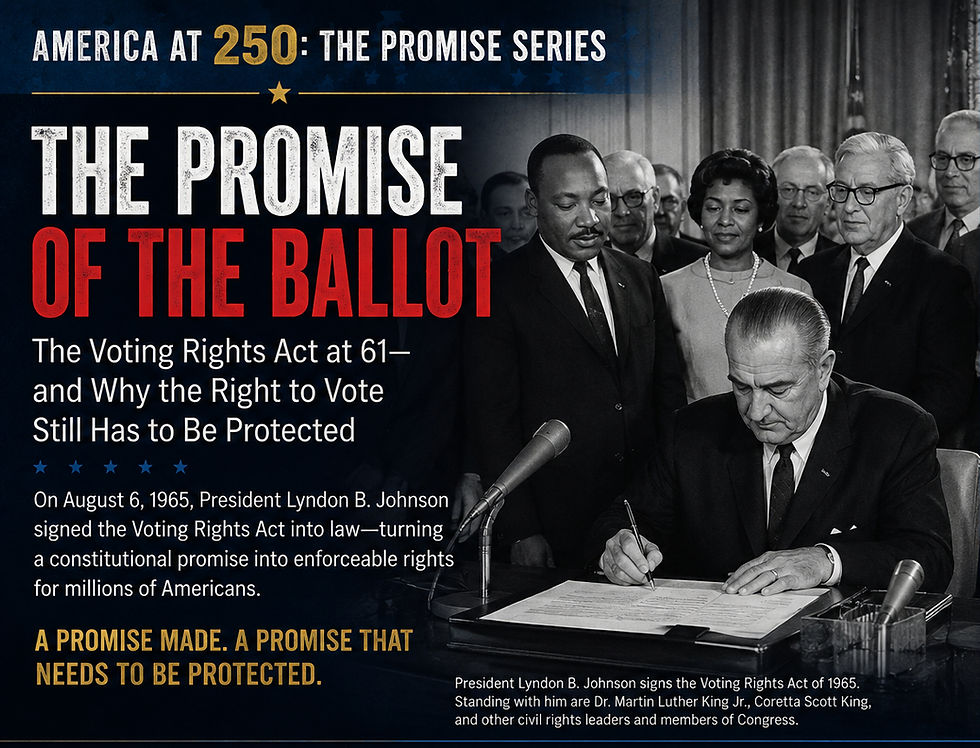
That work contributed to passage of the Voting Rights Act of 1965—45 years after the 19th Amendment was ratified. The act finally gave the federal government stronger tools to confront the discriminatory practices that had kept generations of Black citizens from the polls.
The journey from 1920 to 1965 reminds us that constitutional rights do not enforce themselves. They require laws, institutions and people willing to defend them.
The Same Promise, New Barriers
The methods used to restrict voting have changed since 1920.
Modern voter suppression does not usually announce itself with a sign declaring that women, Black citizens or another group cannot vote. Instead, it can appear through identification requirements, registration purges, reduced voting opportunities, documentary requirements, inaccessible polling locations and restrictions on mail ballots.
Each rule may be presented as a matter of election security. But their combined effect can determine which eligible citizens successfully cast a ballot—and which encounter one barrier too many.
That distinction is important because election security and voting access should not be opposing goals. Americans deserve elections that are secure, accurately administered and accessible to every eligible voter.
The danger comes when preventing a small or hypothetical risk is used to justify requirements that obstruct large numbers of lawful voters.
A New “Show Your Papers” Requirement
Congress is currently considering versions of the SAVE Act and SAVE America Act that would require citizens to present documents such as a passport or birth certificate when registering or updating their voter registration.
The Brennan Center for Justice estimates that more than 21 million voting-age American citizens do not have ready access to those documents.
The proposed requirements could create a particular burden for married women whose current legal names do not match the names printed on their birth certificates. Those women could be required to produce additional documents—such as marriage certificates or court records—before being allowed to register.
That creates a bitter historical irony.
More than a century after women fought to remove sex as a barrier to voting, millions could face new difficulties because their names changed through marriage.
Younger voters, lower-income citizens, people who move frequently, rural residents, naturalized citizens and voters of color could also face disproportionate obstacles. The issue is not whether these citizens are legally eligible. The issue is whether they possess the exact paperwork demanded by the government at the moment they attempt to register.
Mail Voting Under Pressure
Mail voting has also become a central target.
On March 31, 2026, President Donald Trump issued an executive order directing the creation of federal citizen-resident lists and ordering the United States Postal Service to refuse certain mail ballots that did not comply with new federal requirements.
The administration argues that the measures are needed to confirm citizenship, prevent fraud and strengthen confidence in election results.
Opponents—including voting-rights organizations, state officials and election administrators—argue that the order exceeds presidential authority and could prevent eligible citizens from receiving or returning their ballots.
Federal courts have blocked portions of the order. The administration has asked the United States Supreme Court to allow some of those provisions to take effect before the November 3, 2026, midterm election. As of this writing, the litigation remains active.
The dispute raises a fundamental constitutional question: Can a president impose national voting procedures through executive action when the Constitution gives much of the responsibility for conducting elections to the states and Congress?
It also raises a more immediate human question:
What happens to the voter whose legally cast ballot is caught between changing rules, government databases and postal deadlines?
The Ohio Connection

The issue is not confined to Washington.
Under a new Ohio requirement, absentee ballots must be received by the voter’s county board of elections before the polls close at 7:30 p.m. on Election Day. A ballot delayed in the mail may not be counted simply because the voter mailed it before Election Day.
Ohio election officials are therefore urging absentee voters to request and return their ballots early or personally deliver them to their county board of elections or its official drop box.
The rule makes voter education essential. A citizen can follow the old procedure in good faith, mail a completed ballot before Election Day and still discover that the ballot arrived too late to count.
That is how voting access can be narrowed without anyone formally taking away the right to vote.
The Difference Between Having a Right and Reaching It
The connection between the 19th Amendment and today’s voting battles is not merely symbolic.
The amendment demonstrates that placing a right in the Constitution does not guarantee that every eligible citizen will be able to exercise it equally.
In 1920, Black women legally gained protection against voting discrimination based on sex. Yet poll taxes, literacy tests, intimidation and discriminatory registration practices continued preventing many from voting.
Today’s barriers use different language, but the underlying lesson remains:
A right can exist in law while being obstructed in practice.
The modern voter may not be asked to interpret a deliberately confusing passage of the Constitution, as Black citizens once were under literacy tests. But that voter may be required to locate a birth certificate issued decades ago, produce documentation connecting a birth name to a married name, travel to an election office, correct a database mismatch or trust that a ballot will move through the mail before a newly imposed deadline.
The mechanism has changed.
The effect can be the same: an eligible citizen is prevented from participating.
A Promise We Must Protect
As America approaches its 250th anniversary, the 19th Amendment should be remembered as both an achievement and an assignment.
It proved that ordinary people, organized across generations, could force the nation to expand its definition of citizenship. Women who had been told that politics was not their place changed the Constitution itself.
But the amendment’s incomplete reach warns us against confusing a promise made with a promise fulfilled.
Protecting democracy requires more than opposing election fraud. It also requires opposing unnecessary barriers that prevent lawful voters from participating.
It means verifying our registrations, understanding current voting requirements, helping neighbors obtain the information and identification they need, supporting nonpartisan voter-education efforts and holding public officials accountable when election rules threaten access to the ballot.
The women who fought for the 19th Amendment understood that voting was not merely a personal privilege. It was a form of public power—the ability to influence laws, select leaders and hold government accountable.
That power is why the vote was denied for so long.
It is also why the vote remains contested.
The 19th Amendment expanded America’s promise. The women who continued fighting after its ratification pushed that promise closer to reality.
The responsibility for carrying it forward now belongs to us.
Because democracy is not secured merely when rights are written into the Constitution.
Democracy is secured when every eligible citizen can exercise those rights freely, safely and without unnecessary obstruction.
And that remains a promise worth defending.


Comments